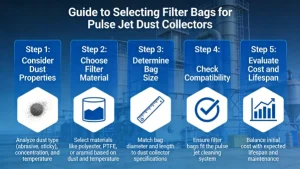
To select the right filter bags for a pulse jet dust collector, follow this step-by-step guide focusing on material compatibility, dust characteristics, operating conditions, and system requirements. Start with these critical decisions: temperature resistance → chemical compatibility → dust properties → media type & treatment → dimensions & installation → performance optimization.
Step 1: Understand Pulse Jet System Requirements
Pulse jet collectors use high-pressure air bursts (60-120 psi) to clean filter bags, requiring media that withstands:
- Frequent expansion-contraction cycles (20,000+ pulses/year)
- External dust loading (dust cakes on the outside of bags)
- Higher air-to-cloth ratios (1.0-1.5 m/min typical) vs. shaker/reverse-air systems
- Non-woven needle-punched felts are preferred for durability and cleaning efficiency
Step 2: Analyze Operating Conditions
2.1 Temperature Resistance
| Temperature Range | Recommended Materials | Key Considerations |
|---|---|---|
| ≤130°C (266°F) | Polyester (PET), Polypropylene | Cost-effective, good abrasion resistance |
| 130-190°C (266-374°F) | PPS (Ryton), Acrylic, Meta-aramid (Nomex) | PPS best for acidic environments |
| 190-260°C (374-500°F) | P84 (Polyimide), PTFE-blended | P84 has excellent chemical resistance |
| >260°C (500°F) | PTFE (Teflon), Glass fiber (with PTFE coating) | Glass fiber needs anti-friction treatment |
Critical Rule: Operating temperature must be 20°C above dew point to prevent condensation and bag failure .
2.2 Chemical Compatibility
Match material to gas/dust chemistry:
- Acidic gases (pH <5): PPS, PTFE, P84 (avoid polyester)
- Alkaline gases (pH >9): Polypropylene, PTFE (avoid PPS)
- Oxidizing environments: PTFE, Meta-aramid (avoid PPS at >15% O₂)
- Organic solvents: PTFE, Polypropylene
- Moisture/humidity >60%: PTFE, hydrophobic-treated polyester
Step 3: Evaluate Dust Characteristics
| Dust Property | Selection Criteria | Recommended Media |
|---|---|---|
| Particle size (D50 <5μm) | Surface filtration (low penetration) | PTFE membrane or ultra-fine fiber felts |
| Abrasive (sharp edges) | High tensile strength, wear-resistant surface | Polyester, PPS with PTFE coating; avoid glass fiber |
| Sticky/hygroscopic | Low surface energy, anti-static treatment | PTFE membrane, silicone/polytetrafluoroethylene (PTFE) finish |
| Combustible/explosive | Anti-static properties (conductive fibers) | Polyester with carbon fiber blend or antistatic finish |
| High concentration (>100 g/m³) | High permeability, robust cleaning ability | Needle-punched felts with calendering treatment |
Step 4: Select Filter Media Type & Treatment
4.1 Media Structure
- Needle-punched felt: Standard for pulse jet systems; excellent dust release, durability, and airflow balance
- Woven fabrics: Used for coarse dust or high-temperature applications; less common for pulse jet
- Pleated bags: Increase filtration area by 200-300%; ideal for space constraints
4.2 Surface Treatments (Critical for Pulse Jet Performance)
| Treatment | Purpose | Best For |
|---|---|---|
| PTFE membrane lamination | 99.99% efficiency for submicron particles, easy dust release | Fine/abrasive dust, high emission standards |
| Calendering | Smooth surface, reduced friction, improved cleaning | Sticky dust, high air-to-cloth ratios |
| Glazing | Enhanced dust cake release, lower pressure drop | Hygroscopic or cohesive dust |
| Water/oil repellent | Prevents moisture absorption and bag clogging | High humidity or oil mist environments |
| Anti-static | Dissipates static electricity (10⁶-10⁹ Ω surface resistance) | Combustible dust (NFPA 652 compliance) |
Step 5: Determine Filter Bag Dimensions
- Diameter: Standard sizes: 120mm, 130mm, 160mm (4-6 inches)
- Larger diameters (160mm) reduce pressure drop but require more space
- Smaller diameters (120mm) better for sticky dust with frequent cleaning
- Length: 2-6 meters (6-20 feet); up to 7.9m (26ft) in specialized systems
- Balance: Longer bags increase filtration area but require stronger cages and higher cleaning energy
- Filter Area Calculation:
plaintext
Required Area (m²) = Airflow (m³/h) ÷ (Filtration Velocity (m/min) × 60)
- Typical pulse jet velocity: 1.0-1.5 m/min (adjust for dust type: lower for fine/sticky dust)
Step 6: Installation & Compatibility Considerations
- Cage compatibility: Ensure bag dimensions match cage precisely (1-2mm clearance)
- Sealing mechanism:
- Snap band: Quick installation, good for standard applications
- Velcro: Reusable, ideal for frequent bag changes
- Glued collar: Permanent, best for high-temperature or high-pressure systems
- Top/bottom construction:
- Open top with spring: Standard for most pulse jet collectors
- Closed top: For vertical airflow or 特殊 applications
Step 7: Performance Optimization & Maintenance
7.1 Key Performance Metrics
- Air permeability: 100-200 L/dm²/min (at 200 Pa) – balance airflow and efficiency
- Pressure drop: Target 1000-1500 Pa during operation; excessive drop indicates clogging
- Dust emission: <5 mg/m³ for most industrial applications; <1 mg/m³ with membrane filters
7.2 Maintenance Best Practices
- Inspection frequency: Monthly for pressure drop; quarterly for physical condition
- Replacement schedule: Based on:
- Pressure drop increase of >50% from baseline
- Visual damage (holes, tears, seam separation)
- Emission levels exceeding regulatory limits
- Common Failure Modes & Solutions:
- Cracking/brittleness: Wrong temperature rating → upgrade to higher temp material
- Clogging: Inadequate cleaning or wrong treatment → adjust pulse timing or add PTFE membrane
- Abrasion: Sharp dust → use wear-resistant material or add protective patch
Step 8: Final Selection Checklist
Before purchasing, verify:
- Operating temperature < material’s maximum continuous rating (with 20°C safety margin)
- Chemical compatibility with both gas and dust components
- Media type matches dust characteristics (abrasive, sticky, fine, combustible)
- Dimensions fit collector and cage system precisely
- Surface treatment addresses specific challenges (PTFE membrane for fine dust, anti-static for combustible)
- Cost-benefit analysis: Premium materials (PPS, PTFE) may save money long-term vs. frequent replacements
Quick Reference: Material Selection Guide for Common Industries
| Industry | Dust Type | Recommended Material | Treatment |
|---|---|---|---|
| Cement/Lime | Abrasive, alkaline | Polyester or PPS | Calendering + anti-static |
| Metalworking | Fine, potentially combustible | Polyester with PTFE membrane | Anti-static finish |
| Chemical Processing | Corrosive, varying pH | PTFE or PPS | PTFE membrane |
| Power Generation | Fly ash, acidic | PPS + PTFE membrane | Heat-resistant finish |
| Food Processing | Fine, organic | Polypropylene | Food-grade certification |
| Woodworking | Sawdust, low abrasion | Polyester | Standard finish |
Selecting filter bags for pulse jet collectors requires a systematic approach that prioritizes temperature and chemical compatibility first, then addresses dust properties and operational needs. The right combination of material, structure, and treatment will maximize efficiency, minimize maintenance, and ensure long service life. Always consult with filter manufacturers for application-specific recommendations, especially for extreme conditions.