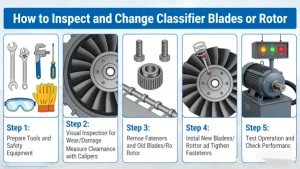
Quick Start Checklist:
- LOTO (Lockout/Tagout) the machine before any work
- Inspect blades for wear, cracks, and balance issues
- Replace in pairs (opposite blades) to maintain balance
- Clean & prepare mounting surfaces thoroughly
- Torque fasteners to specification using diagonal pattern
- Re-balance the rotor assembly before startup
- Test run with monitoring for vibration and performance
I. Preparatory & Safety Procedures
1. Lockout/Tagout (LOTO) Protocol (Critical First Step)
- Notify all affected personnel about maintenance work
- Shut down the classifier and main mill system through proper procedures
- Isolate all energy sources: electrical, pneumatic, hydraulic, and mechanical
- Lockout/tagout all isolation points with individual locks and tags (one lock per person)
- Verify zero energy state: test start buttons, check for residual pressure/movement
- Release stored energy: bleed air lines, relieve hydraulic pressure, and secure moving parts
2. Preparation
- Gather appropriate tools: torque wrench, blade puller (if needed), cleaning supplies, measuring tools, and personal protective equipment (PPE)
- Ensure replacement blades match exact specifications (material, dimensions, weight)
- Clear the work area and ensure adequate lighting/ventilation
- Review the manufacturer’s maintenance manual for specific instructions
II. Inspection Procedures
1. Visual Inspection (Entry to Classifier Housing)
| Inspection Item | Criteria for Replacement |
|---|---|
| Blade edges | Worn beyond 20-30% of original thickness, nicks, or rounded edges |
| Surface condition | Cracks, pitting, corrosion, or deformation |
| Mounting area | Loose bolts, damaged threads, or worn contact surfaces |
| Rotor body | Bent shafts, cracks, or imbalance indicators |
| Seals & bearings | Leakage, excessive play, or abnormal noise |
2. Dimensional & Wear Measurement
- Use calipers/micrometers to measure blade height, thickness, and edge profile
- Check blade-to-housing clearance (should match design specifications)
- Document wear patterns to identify potential operational issues
- For severe service (abrasive materials like calcium carbonate), increase inspection frequency
3. Balance Check
- Rotate the rotor manually to check for binding or uneven resistance
- Look for signs of imbalance: excessive vibration history or uneven wear patterns
- Measure blade weight differences (should be within ±1g for critical applications)
III. Blade Replacement Procedure
1. Removal of Old Blades
- Mark positions: Note each blade’s orientation and location for correct reassembly
- Loosen bolts in diagonal sequence (prevents warping)
- Support blades during removal to prevent damage or injury
- Clean mounting surfaces: Remove rust, old gaskets, and debris with a scraper/emery paper
- Inspect hub: Check for wear, cracks, or damage that may require rotor replacement
2. Installation of New Blades
- Verify specifications: Ensure new blades match original dimensions, material, and weight
- Clean & prepare: Degrease all contact surfaces; apply anti-seize compound if recommended
- Install in pairs: Always replace opposite blades together to maintain balance
- Torque bolts to manufacturer’s specification using cross-pattern
- Double-check clearances: Ensure proper blade-to-housing gap (typically 1-3mm)
IV. Rotor Replacement (When Needed)
1. Rotor Removal
- Disconnect drive: Remove coupling, belt, or gear connection
- Support rotor: Use lifting equipment rated for the weight
- Remove fasteners: Take off retaining nuts, keys, or locking devices
- Extract rotor: Use appropriate pullers (avoid hammering directly on shaft)
- Inspect bearings: Check for damage and replace if necessary
2. Rotor Installation
- Clean shaft & housing: Remove old lubricant and debris
- Check fit: Verify shaft-to-rotor bore alignment and keyway condition
- Install seals: Replace worn seals before mounting the new rotor
- Mount rotor: Slide carefully onto shaft; use even pressure
- Secure properly: Torque retaining nuts to specification; install locking devices
V. Balancing & Quality Assurance
1. Rotor Balancing (Critical Step)
- Static balance: Place rotor on knife edges; check for rolling (indicates imbalance)
- Dynamic balancing (recommended for high-speed classifiers):
- Use a balancing machine to measure vibration at operational speeds
- Add/remove weights at specified locations to achieve acceptable balance
- Verify balance within manufacturer’s tolerance (typically <0.05mm vibration)
2. Post-Installation Checks
- Manual rotation: Spin rotor by hand to check for binding or interference
- Bolt verification: Recheck torque after initial rotation
- Seal inspection: Ensure proper sealing to prevent air leaks
- Documentation: Record blade serial numbers, installation date, and torque values
VI. Post-Maintenance Startup & Monitoring
- Reconnect systems: Restore all energy connections (reverse of isolation steps)
- Clear work area: Remove tools, debris, and personnel from danger zones
- Test run:
- Start at reduced speed for initial 10-15 minutes
- Monitor vibration levels (use a vibration meter)
- Check for unusual noise, overheating, or performance issues
- Tightness verification: Recheck blade bolts after 8 hours of operation (repeat until no loosening)
- Performance validation: Test classification efficiency and particle size distribution
VII. Maintenance Schedule Recommendations
| Interval | Inspection Tasks |
|---|---|
| Daily | Visual check for vibration, noise, and air leaks |
| Weekly | Inspect blade condition through access ports (if available) |
| Monthly | Full inspection for abrasive materials; check bolt tightness |
| Quarterly | Thorough blade measurement; check balance and clearances |
| Annually | Complete disassembly, rotor inspection, and balance verification |
Key Safety Reminders
- Always wear PPE: Cut-resistant gloves, safety glasses, steel-toed shoes, and hearing protection
- Never work alone: Have a second person available for assistance/emergencies
- Follow manufacturer guidelines: Never deviate from specified procedures or torque values
- Document everything: Maintain records of inspections, replacements, and balance data for future reference
Note: Specific procedures may vary by classifier model (e.g., Raymond mill, air classifying mill, dynamic classifier). Always consult your equipment’s operation and maintenance manual for detailed instructions tailored to your system .