CaCO3
ЯКАН

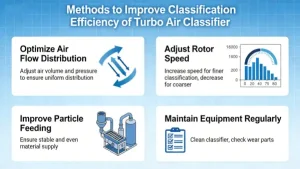
How to improve the classification efficiency of a turbo air classifier

Here’s a practical, industrial-grade summary for optimizing turbo air classifier performance (widely used in CaCO₃, graphite, fine powder grinding systems): 1. Optimize rotor speed (most important) Rotor speed directly controls the cut size (d₅₀). Too high: high energy consumption, over-grinding, reduced yield. Too low: coarse particles enter fine product, low sharpness. Action: Fine-tune speed until coarse powder contains almost no qualified fine particles. 2. Match air volume & air velocity Air flow carries and disperses powder; speed and air volume must be matched. Excessive air: carries coarse particles into fines. Insufficient air: cannot lift fine powder, low classification efficiency. Action: Adjust primary/secondary air ratio to create stable, uniform flow field. 3. Improve feed dispersion & uniformity Agglomerated feed is the…

Here’s a practical, industrial-grade summary for optimizing turbo air classifier performance (widely used in CaCO₃, graphite, fine powder grinding systems):

1. Optimize rotor speed (most important)

  • Rotor speed directly controls the cut size (d₅₀).
    • Too high: high energy consumption, over-grinding, reduced yield.
    • Too low: coarse particles enter fine product, low sharpness.
  • Action: Fine-tune speed until coarse powder contains almost no qualified fine particles.

2. Match air volume & air velocity

  • Air flow carries and disperses powder; speed and air volume must be matched.
    • Excessive air: carries coarse particles into fines.
    • Insufficient air: cannot lift fine powder, low classification efficiency.
  • Action: Adjust primary/secondary air ratio to create stable, uniform flow field.

3. Improve feed dispersion & uniformity

  • Agglomerated feed is the main cause of low efficiency.
  • Control moisture < 1% (critical for non-metallic minerals).
  • Use a disperser or feeder to ensure powder enters the classification zone evenly and dispersed.

4. Optimize secondary air & air distribution

  • Secondary air breaks up agglomerates and stabilizes the flow field.
  • Adjust air distributor and guide vanes to eliminate bias flow and turbulence.

5. Minimize internal leakage & short-circuit flow

  • Reduce gaps between rotor and casing to prevent coarse powder from bypassing classification.
  • Check and maintain seals; worn parts increase bypass and reduce efficiency.

6. Stabilize system pressure

  • Keep system negative pressure stable.
  • Pressure fluctuation destroys the classification flow field and causes efficiency drop.

7. Regular maintenance

  • Clean powder buildup on rotor blades.
  • Check blade wear, rotor balance, and bearing condition.
  • Worn or unbalanced rotors cause vibration and poor classification.
About Us:
With over 20 years of dedicated expertise in ultrafine grinding technology, we deliver high-performance machinery that matches the precision and reliability of leading German and Japanese brands—at only 1/3 of their cost.

Beyond Equipment, We Deliver Total Confidence:
We provide Free Material Testing to ensure precise equipment selection, followed by professional on-site installation and comprehensive training. Our 24/7 technical support team ensures your production line remains efficient and worry-free.

Schedule Material Trial & Get a Customized Solution from Us
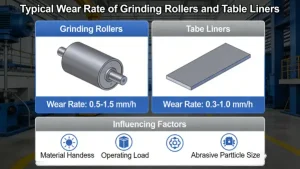
What is the typical wear rate of grinding rollers and table liners?
The wear rate of grinding rollers and table liners in vertical roller mills (VRMs) varies...
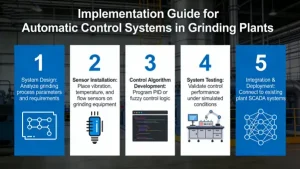
How to implement automatic control systems for grinding plants
To implement automatic control for grinding plants effectively, follow a layered architecture with phased deployment,...
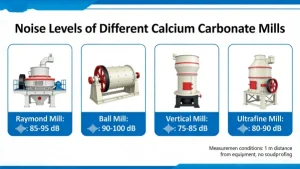
What is the noise level of different types of calcium carbonate mills?
1. Ball Mill Noise Level: 95-120 dB(A) This is one of the loudest industrial grinding...