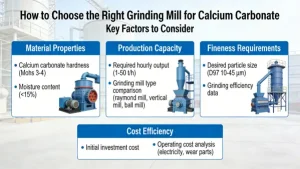
Start with a clear decision framework: first define production method (dry/wet), target fineness, and throughput, then align with material properties, energy costs, and application requirements to select the optimal mill type.
1. Define Core Requirements First
Production Method: Dry vs. Wet Grinding
| Method | Best For | Particle Size Range | Key Advantages | Key Disadvantages |
|---|---|---|---|---|
| Dry Grinding | General applications, cost-sensitive, easy transportation | Up to 1500 mesh (≈10μm) | Lower investment, easy operation, flexible production, easy to modify products | Coarser particles, wider distribution, higher energy for ultra-fine |
| Wet Grinding | High-purity, ultra-fine, special applications | 1500–6500+ mesh (≈2.5–0.5μm) | Ultra-fine particles, narrow distribution, high solid content, good dispersion | Higher investment, complex operation, difficult transportation (slurry) |
Key Parameters to Specify
- Material Properties: Mohs hardness (CaCO₃ is 3, soft), moisture content (<5% for dry grinding), purity
- Feed Size: Determines pre-crushing needs (e.g., Raymond mill needs 25–35mm feed)
- Target Fineness:
- Coarse: 325–400 mesh (45–38μm) – construction, paper
- Fine: 800 mesh (18μm) – paint, plastic
- Ultra-fine: 1500–6500 mesh (10–0.5μm) – pharmaceuticals, advanced coatings
- Required Capacity: Tons per hour (TPH) or annual output (leave 10–20% margin)
- Application-Specific Needs: Particle shape (spherical vs. irregular), narrow size distribution, purity
2. Common Mill Types for Calcium Carbonate: Specifications & Applications
Raymond Mill (Traditional Pendulum Mill)
- Output Size: 45–180μm (80–325 mesh)
- Feed Size: 25–35mm
- Capacity: 1–30 TPH
- Best For: Coarse to medium powder, general applications, cost-sensitive projects
- Advantages: Low energy consumption, small footprint, easy maintenance, 99% pass rate
- Limitations: Cannot produce ultra-fine powder (<45μm)
Ball Mill with Classifier
- Output Size: 5–45μm (325–2500 mesh)
- Feed Size: 0–4mm
- Capacity: 10,000–200,000 tons/year
- Best For: Mid-to-high-end applications requiring good particle shape and stable quality
- Advantages: Versatile (handles all hardness), excellent particle shape, reliable operation
- Limitations: Higher energy consumption, higher investment
Vertical Mill
- Output Size: 3–45μm (325–2500 mesh)
- Feed Size: 0–40mm
- Capacity: Large-scale production (20–100+ TPH)
- Best For: Large capacity, energy-saving requirements, integrated drying-grinding
- Advantages: 30–50% lower energy than ball mill, small footprint, high efficiency
- Limitations: Higher initial cost, less flexible for small batches
Micro Powder Roller Mill
- Output Size: 5–45μm (325–2500 mesh)
- Feed Size: 0–10mm
- Capacity: Medium (5–20 TPH)
- Best For: Fine to ultra-fine powder, budget-conscious projects
- Advantages: Low energy, long service life, multi-roller design for higher output
- Limitations: Less suitable for extremely hard materials
Wet Grinding Mill (Stirred Mill)
- Output Size: 0–5μm (2500–8000+ mesh)
- Feed Size: ~45μm (pre-ground)
- Capacity: Medium to large (10–50 TPH)
- Best For: Ultra-fine, high-purity applications (inks, cosmetics, pharmaceuticals)
- Advantages: Narrow particle distribution, high purity, good dispersion
- Limitations: Complex process, higher operating costs, requires dewatering
Air Jet Mill
- Output Size: 0.5–45μm (ultra-fine to fine)
- Feed Size: <800μm
- Capacity: Laboratory (0.1–0.5 kg/h) to industrial (up to 4000 kg/h)
- Best For: High-purity, narrow distribution, pharmaceutical/food-grade applications
- Advantages: Contamination-free, smooth particle surface, precise classification
- Limitations: High energy consumption, high operational cost
3. Critical Selection Factors
1. Material Characteristics
- Calcium carbonate (Mohs 3, soft) works with all mill types
- Raw material type (limestone, marble, chalk) affects wear rates and output quality
- Moisture content >5% may require drying before dry grinding
2. Fineness Requirements (Most Important)
| Fineness | Recommended Mill | Process |
|---|---|---|
| 325–400 mesh (38–45μm) | Raymond mill, Vertical mill | Dry |
| 800 mesh (18μm) | Micro powder roller mill, Ball mill | Dry |
| 1500–2500 mesh (5–10μm) | Ball mill, Vertical mill, Micro powder mill | Dry or Wet |
| 2500–6500+ mesh (<5μm) | Wet grinding mill, Jet mill | Wet preferred |
3. Production Capacity
- Small scale (<5 TPH): Raymond mill, Micro powder roller mill
- Medium scale (5–20 TPH): Ball mill, Vertical mill, Micro powder mill
- Large scale (>20 TPH): Vertical mill, Ball mill (multiple units)
- Ultra-fine small scale: Jet mill (laboratory), Wet grinding mill (small batch)
4. Energy Efficiency
- Most efficient: Vertical mill (30–50% less than ball mill)
- Medium efficiency: Raymond mill, Micro powder roller mill
- Least efficient: Ball mill, Wet grinding mill, Jet mill
5. Particle Shape & Quality
- Spherical particles: Jet mill, Ball mill
- Irregular particles: Raymond mill, Vertical mill
- High purity requirements: Jet mill (no contamination), Wet grinding mill (purification)
6. Cost Considerations
- Initial investment: Raymond mill < Micro powder roller mill < Ball mill < Vertical mill < Jet mill
- Operating costs: Energy (highest for jet/wet mills), wear parts, maintenance
- ROI: Shortest for Raymond mill (coarse powder), longest for jet mill (specialty applications)
7. Maintenance & Operation
- Easy maintenance: Raymond mill, Micro powder roller mill
- Complex maintenance: Ball mill, Vertical mill, Jet mill
- Automation: Vertical mill, Jet mill (PLC control available)
- Space requirements: Vertical mill (smallest footprint), Ball mill (largest)
4. Step-by-Step Selection Guide
- Determine Production Method: Choose dry for <1500 mesh, wet for >2500 mesh
- Define Fineness & Capacity: Match with mill type capabilities (use the tables above)
- Evaluate Material Properties: Ensure compatibility with selected mill
- Assess Energy & Cost: Balance initial investment vs. long-term operational costs
- Consider Application Needs: Particle shape, purity, distribution requirements
- Evaluate Maintenance & Space: Align with your operational capabilities
- Consult Experts: Get recommendations from manufacturers with calcium carbonate experience
5. Application-Specific Recommendations
| Industry | Required Fineness | Recommended Mill | Key Considerations |
|---|---|---|---|
| Construction | 325 mesh | Raymond mill, Vertical mill | Cost efficiency, high throughput |
| Paper | 325–400 mesh | Raymond mill, Ball mill | Whiteness, particle size uniformity |
| Plastics/Rubber | 400 mesh | Raymond mill, Micro powder roller mill | Cost reduction, strength improvement |
| Paint/Coatings | 800 mesh | Ball mill, Micro powder roller mill | High filling rate (>30%), dispersion |
| Pharmaceuticals | 2500+ mesh | Jet mill, Wet grinding mill | High purity, narrow distribution |
| Cosmetics | 2500+ mesh | Jet mill, Wet grinding mill | Smooth particle surface, safety |
Final Checklist Before Purchase
✅ Confirm mill can handle your feed size without additional crushing
✅ Verify fineness range matches your target (ask for test reports)
✅ Calculate energy consumption vs. expected output (check kWh/ton)
✅ Ensure maintenance requirements align with your team’s capabilities
✅ Check availability of spare parts and after-sales service
✅ Request on-site testing with your actual calcium carbonate material
By following this comprehensive guide, you’ll select the most suitable grinding mill for your calcium carbonate processing needs, balancing performance, cost, and operational efficiency.