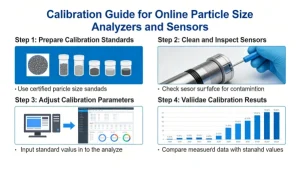
Calibrating online particle size analyzers requires a structured approach combining instrument-specific procedures, certified reference materials (CRMs), and adherence to international standards. Below is a comprehensive guide covering key concepts, methods, and step-by-step workflows.
Key Concepts: Calibration vs. Verification
| Term | Definition | Application |
|---|---|---|
| Calibration | Adjusting instrument to match traceable reference values | For particle counters, some imaging systems |
| Verification | Confirming instrument meets performance specs without adjustment | For laser diffraction, DLS (based on first principles) |
| Validation | Ensuring measurement fits intended use in process | All online analyzers |
Step-by-Step Calibration/Verification Process
1. Preparation and Pre-Calibration Checks
- Instrument preparation:
- Power on and preheat (typically 30-60 min) to stabilize lasers, detectors, and electronics
- Clean optical components (lenses, windows, sapphire surfaces) to remove process deposits
- Verify process conditions (temperature, pressure, flow rate) match calibration environment
- Confirm sample presentation (probe positioning, mixing) ensures representative measurement
- Documentation:
- Record instrument ID, serial number, firmware version
- Document ambient conditions (temperature, humidity)
- Note previous calibration date and results
- Review manufacturer’s SOP for specific requirements
2. Reference Material Selection and Preparation
- Critical requirements for CRMs:
- Traceability to national/international standards (NIST, ISO)ISO
- Certified particle size distribution (d10, d50, d90 with uncertainties)
- Matrix matching: Similar refractive index, density, and shape to process particles
- Stability: No agglomeration or settling during measurement
- Common CRM types:
- Polystyrene latex (PSL) spheres (for particle counters)ISO
- Silica, alumina, or glass beads (for laser diffraction)
- Certified test dusts (ISO 12103-1, A1, A2, A3 for liquid systems)
- Preparation steps:
- Weigh precise amount of CRM (follow certificate instructions)
- Disperse in appropriate carrier fluid (filtered, particle-free)
- Use ultrasonic bath if needed to break agglomerates (avoid over-sonication)
- Verify concentration is within instrument’s linear rangeISO
- Degas to remove bubbles that interfere with optical measurements
3. Baseline Measurement (Background)
- Perform background measurement with particle-free carrier fluid to:
- Subtract system noise from subsequent measurements
- Verify cleanliness of flow cell, tubing, and optical path
- Confirm absence of air bubbles or contamination
4. Measurement Execution
- Reference measurement:
- Introduce CRM suspension to instrument (follow manufacturer’s flow rate/pressure guidelines)
- Collect multiple readings (5-10 replicates) to ensure statistical reliability
- For laser diffraction: Use appropriate optical model (Mie, Fraunhofer) based on particle propertiesISO
- For imaging systems: Verify focus, magnification, and lighting settings
- Process measurement comparison (for validation):
- Measure actual process stream (before/after CRM verification)
- Compare with offline reference method (sieve analysis, microscopy) if available
- Document any significant deviations
5. Data Analysis and Acceptance Criteria
- Performance evaluation parameters:
Parameter Acceptance Criteria Application Accuracy d50: ±3% of certified valued10/d90: ±5% of certified value Laser diffraction Precision COV (Coefficient of Variation) < 3% for d50COV < 5% for d10/d90 All techniques Resolution Ability to distinguish between two particle populations Particle counters, imaging systemsISO Linearity Response proportional to particle concentration All analyzersISO - Decision making:
- If results within tolerance: Document and proceed to finalization
- If results outside tolerance:
- Recheck CRM preparation and measurement conditions
- Clean optics and repeat measurement
- Perform instrument adjustment (only if calibration is applicable)
- If issues persist, contact manufacturer service
6. Calibration Adjustment (When Applicable)
- For instruments requiring calibration:
- Access calibration mode in software
- Input certified CRM values
- Allow instrument to adjust internal parameters (gain, offset, detection thresholds)
- Repeat measurement with CRM to confirm adjustment effectiveness
- Lock calibration settings (password protection recommended)
7. Post-Calibration Verification and Documentation
- Final verification:
- Measure second aliquot of CRM to confirm consistency
- Check instrument response with blank (particle-free fluid) to ensure no carryover
- Verify process connectivity and return to online operation
- Documentation requirements:
- Calibration certificate with all measured values and uncertainties
- Reference material certificate number and expiration date
- Instrument settings used during calibration
- Deviations from standard procedure and corrective actions
- Date and signature of calibrating technician
- Next calibration due date (based on usage, process conditions, and manufacturer recommendations)
Instrument-Specific Calibration Methods
Laser Diffraction Online Analyzers
- Verification approach (not typically calibrated):
- Use photomask reticles (ASTM E1458) with precise aperture arrays to simulate particle distributions
- Or certified spherical particles (NIST traceable) to confirm optical system performance
- Key parameters: Optical alignment, detector sensitivity, and data processing algorithms
- Procedure highlights:
- Perform background measurement with filtered carrier
- Introduce CRM suspension at recommended flow rate
- Measure and compare d-values to certified ranges
- Check for optical misalignment if deviations exceed specs
Particle Counters (Light Extinction/Scattering)
- Primary calibration (traceable to NIST):
- Use monodisperse PSL spheres to determine size thresholds and counting efficiencyISO
- Establish size channels (e.g., 4μm, 6μm, 14μm) with known particle standards
- Follow ISO 11171 for liquid particle countersISO
- Secondary calibration:
- Use suspensions verified by primary calibrated instrument
- Match two or more online particle counters for consistent results
Dynamic Light Scattering (DLS) Online Sensors
- Verification with CRM:
- Use narrow distribution PSL spheres (10nm-1μm range)ISO
- Verify correlation function analysis and size calculation
- Check for multiple scattering effects (adjust concentration if needed)ISO
Imaging-Based Online Analyzers
- Calibration steps:
- Spatial calibration: Use stage micrometer to verify pixel-to-length conversion
- Size calibration: Measure certified particle standards of known dimensions
- Shape calibration: Use particles with defined morphology (spherical, cubic, irregular)
- Brightness/contrast optimization: Ensure consistent particle detection
Maintenance and Routine Checks
- Daily/Shift Checks:
- Verify instrument status (no error messages, stable pressure/flow)
- Check optical windows for contamination
- Confirm data transmission to process control system
- Weekly/Monthly Checks:
- Clean sample handling components (tubing, flow cells)
- Perform quick verification with CRM (if feasible)
- Review trend data for measurement stability
- Quarterly/Annual Calibration:
- Full verification/calibration as per procedure above
- Replace worn components (seals, windows, light sources)
- Update software/firmware if recommended by manufacturer
Troubleshooting Common Calibration Issues
| Problem | Possible Cause | Solution |
|---|---|---|
| High measurement variability | Poor CRM dispersion | Improve sonication, use dispersant, filter carrier fluid |
| Deviation from certified values | Optical misalignment | Realign laser, clean lenses, adjust detector position |
| Drifting baseline | Temperature instability | Ensure proper preheating, stabilize ambient conditions |
| No particle detection | Clogged sample line | Clean probe, tubing, and flow cell |
| Overcounting | Air bubbles in system | Degas carrier fluid, check for leaks |
Standards and Compliance
- Key international standards:
- ISO 13320: Laser diffraction particle size analysisISO
- ISO 11171: Calibration of liquid particle countersISO
- ISO 21501-3: Light extinction particle counter calibration
- ASTM E1458: Laser diffraction verification with photomasks
- JJF 2313-2025: Multi-parameter online laser particle size analyzer calibration (China)
- Regulatory considerations:
- Maintain calibration records for audit trails
- Follow GMP, ISO 9001, or industry-specific requirements
- Ensure traceability to national measurement standards
Best Practices for Online Particle Size Analyzer Calibration
- Establish a calibration schedule based on criticality of measurement, process variability, and instrument stability
- Use matrix-matched CRMs to minimize measurement bias
- Document everything (conditions, methods, results, personnel)
- Train operators on proper calibration procedures and troubleshooting
- Implement a preventive maintenance program to reduce calibration frequency
- Validate measurement uncertainty to understand confidence limits in process decisions
Calibration/verification of online particle size analyzers is essential for reliable process control. While procedures vary by instrument type, the core principles of traceability, reference material usage, and performance documentation remain consistent across all technologies. Always follow manufacturer guidelines and applicable standards to ensure accurate and defensible measurements.