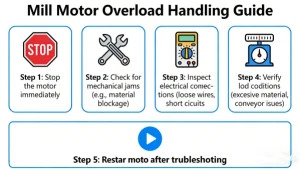
When a grinding mill motor shows excessive current (overload), it means the motor is under abnormal load, which can cause overheating, tripping, or even burnout. Immediate, step-by-step inspection and handling are required as follows:
1. Immediate Emergency Measures
- Stop the mill promptly if the current is far above the rated value or the motor is overheating, to avoid damage to the motor, reducer, or main mill body.
- Do not repeatedly restart the motor blindly; continuous forced starting will worsen winding burnout.
2. Check the Feeding & Grinding Material
- Excessive feed rate: Reduce the feeding amount to the rated capacity; uneven feeding also causes instant overload.
- Hard or uncrushable materials: Metal parts, large hard stones, or high-hardness ore entering the mill will sharply increase load. Check for foreign objects and clean them.
- Material moisture too high: Wet, sticky materials adhere to the grinding chamber/liners, increasing rotational resistance. Dry materials or lower moisture content.
3. Inspect the Grinding Chamber Internal Conditions
- Overfilling of grinding media (balls/rollers): Excess balls/pebbles raise load; adjust to the standard loading ratio.
- Liner or diaphragm damage: Deformed liners or blocked discharge diaphragms change motion resistance; inspect and replace worn parts.
- Blocked discharge port: Slag/powder cannot be discharged in time, causing material accumulation and overload. Clear the blockage immediately.
4. Check Mechanical Transmission Parts
- Bearing overheating or seizing: Insufficient lubrication, damaged bearings, or improper clearance increase friction. Replenish grease or replace bearings.
- Coupling misalignment: Misaligned motor-mill coupling causes extra load; recalibrate concentricity.
- Gear/reducer failure: Poor lubrication, worn gears, or tight meshing lead to high resistance. Check oil level and gear condition.
- Belt too tight: Over-tight drive belts increase motor load; adjust belt tension properly.
5. Electrical System Inspection
- Voltage abnormality: Low grid voltage directly causes higher current. Verify three-phase voltage balance.
- Motor winding fault: Short circuit, insulation damage, or poor connection leads to overload. Test insulation resistance with a megohmmeter.
- Incorrect control settings: VFD (variable frequency drive) parameters mismatched; reset frequency, torque limit, and startup mode.
- Overload protection failure: If the protector does not trip normally, calibrate or replace the protection device.
6. Restart & Normal Operation
- After troubleshooting, test run at no load first to confirm normal current.
- Gradually increase feed to rated load, monitor current in real time, and maintain stable feeding and material properties.