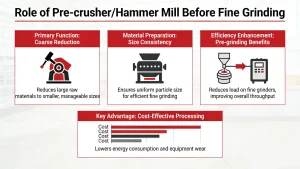
The role of a pre-crusher or hammer mill before a fine grinding circuit is critical for efficiency, equipment protection, and product quality.
In essence, it acts as a preparatory stage, transforming a wide range of raw material sizes into a consistent, manageable feed that the fine grinding mill can handle effectively.
1. Primary Size Reduction
This is the most obvious function. Fine grinding mills (like ball mills, roller mills, or jet mills) are designed to accept a specific, relatively small top size, typically in the range of a few millimeters. They are not designed to handle large chunks.
- The Problem: If a 100mm rock is fed directly into a fine grinder designed for a 5mm top size, it will cause immense stress, potentially leading to mechanical failure, jamming, or catastrophic damage.
- The Solution: The pre-crusher or hammer mill reduces large incoming material (e.g., 50-100mm) down to a size the fine grinder can accept (e.g., <5-10mm).
2. Preventing Equipment Damage and Downtime
This is directly related to the point above. Large, hard, or irregularly shaped objects are the enemy of precision fine grinding equipment.
- Protection: By reducing the material before it reaches the more expensive and delicate fine grinder, the pre-crusher acts as a sacrificial barrier. It handles the heavy, dirty work, protecting the fine grinder’s internals (like bearings, rollers, and screens) from impact and excessive wear.
- Magnet Separation: The pre-crusher stage is an ideal location to install magnetic separators. As the material is being crushed, any tramp metal (like stray bolts, shovel teeth, or nails) is liberated and can be easily removed before it enters and destroys the fine grinding mill.
3. Improving Overall System Efficiency and Throughput
The principle here is that size reduction is more energy-efficient when done in stages.
- Energy Efficiency: Large crushers are more efficient at breaking down large rocks than fine grinders are. Trying to achieve all the size reduction in one machine (the fine grinder) would be incredibly energy-intensive and slow. By distributing the work, you optimize the energy usage of the entire system.
- Increased Throughput: With the pre-crusher handling the coarse reduction, the fine grinder can operate at its optimal feed rate, maximizing the overall output of the system. It prevents the fine grinder from becoming a bottleneck.
4. Creating a Uniform and Consistent Feed
Fine grinders perform best when they receive a consistent stream of material with a predictable particle size distribution.
- Consistency: A pre-crusher ensures that the fine grinder isn’t being fed a mix of dust and boulders. It produces a more homogenous output.
- Controlled Feed Rate: The output from the pre-crusher can be fed into a surge bin or feeder, which then meters a steady, controlled flow of material into the fine grinder. This prevents flooding or starving the fine grinder, both of which lead to inconsistent product quality and operational instability.
5. Liberating Valuable Materials
In many industries, such as mining and recycling, the goal is to separate valuable minerals or materials from a worthless matrix (gangue).
- Liberation: Crushing is the first step in liberating these particles. By breaking the material down, the pre-crusher exposes the individual components, making it easier for the subsequent fine grinding and separation processes to work effectively. A hammer mill, in particular, with its high-speed impact, is excellent for this initial liberation.
Hammer Mill vs. Other Pre-Crushers
While the overall role is the same, the type of machine chosen depends on the material:
- Hammer Mill: Uses high-speed rotating hammers to impact and shatter the material. It’s ideal for friable (brittle) materials like grains, minerals, biomass, and some recycled products. It can also handle materials with some moisture. It produces a relatively wide range of particle sizes.
- Jaw Crusher / Gyratory Crusher / Cone Crusher: These use compression to crush material between two surfaces. They are the classic “pre-crushers” for very hard, abrasive rocks in mining and aggregate industries. They produce a more cubical product than a hammer mill and are better suited for high-hardness materials.
| Role | Benefit | Consequence if Omitted |
|---|---|---|
| Size Reduction | Reduces feed to the correct top size for the fine grinder. | Jamming, damage, and failure of the fine grinder. |
| Protection | Shields expensive fine grinding equipment from impact and wear. | Frequent, costly repairs and unplanned downtime. |
| Efficiency | Distributes the size reduction work for optimal energy use. | High energy consumption, reduced throughput, and higher operating costs. |
| Feed Consistency | Provides a uniform, controllable feed rate to the fine grinder. | Inconsistent product quality, poor process control, and mill “choking” or “starving”. |
| Material Liberation | Begins the process of separating valuable components from waste. | Inefficient downstream separation and loss of valuable product. |
In conclusion, the pre-crusher or hammer mill is not an optional extra but a fundamental component of any efficient and reliable fine grinding circuit. It absorbs the punishment of the raw material, setting the stage for the fine grinder to perform its precision task effectively.