CaCO3
JACAN

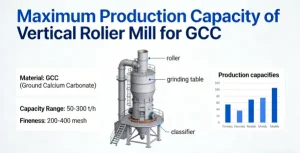
What is the maximum production capacity of a vertical roller mill for GCC?

The maximum production capacity of a vertical roller mill for GCC (Ground Calcium Carbonate) varies significantly depending on the desired product fineness and the specific mill model. Key Capacity Ranges by GCC Fineness GCC Fineness Range Typical Maximum Capacity Ultra-fine GCC (3-22μm, 600-3000 mesh) Up to 50 t/h Standard GCC (22-180μm, 80-325 mesh) Up to 700 t/h Detailed Explanation Ultra-fine GCC Production: For high-end applications like coatings, plastics, and paper, where particle sizes range from 3-22μm (D97), the largest vertical roller mills can achieve up to 50 t/h. The HLMX2800 from Guilin Hongcheng is specifically designed for this purpose and is considered one of the world’s largest ultra-fine vertical roller mills. Standard GCC Production: For general industrial applications with coarser…

The maximum production capacity of a vertical roller mill for GCC (Ground Calcium Carbonate) varies significantly depending on the desired product fineness and the specific mill model.

Key Capacity Ranges by GCC Fineness

GCC Fineness Range Typical Maximum Capacity
Ultra-fine GCC (3-22μm, 600-3000 mesh) Up to 50 t/h
Standard GCC (22-180μm, 80-325 mesh) Up to 700 t/h

Detailed Explanation

  • Ultra-fine GCC Production: For high-end applications like coatings, plastics, and paper, where particle sizes range from 3-22μm (D97), the largest vertical roller mills can achieve up to 50 t/h. The HLMX2800 from Guilin Hongcheng is specifically designed for this purpose and is considered one of the world’s largest ultra-fine vertical roller mills.
  • Standard GCC Production: For general industrial applications with coarser particle sizes (22-180μm), much larger capacities are possible. The HLM series from Guilin Hongcheng can reach up to 700 t/h桂林鸿程, while other manufacturers like SBM offer LM series mills with capacities up to 340 t/h for non-metallic mineral processing including GCC.
  • Capacity vs. Fineness Relationship: Production capacity decreases exponentially as fineness increases. For example, a mill that produces 700 t/h at 180μm might only produce 50 t/h at 10μm particle size.

Industry Context

Vertical roller mills for GCC production integrate crushing, drying, grinding, grading, and conveying into a single unit, making them highly efficient for large-scale operations. The largest models are typically used in massive GCC production facilities serving global markets, while smaller mills (1-40 t/h) are common for regional operations or specialized applications.
Note: These capacities represent state-of-the-art equipment from major manufacturers and may vary based on specific material properties, moisture content, and operating conditions.
About Us:
With over 20 years of dedicated expertise in ultrafine grinding technology, we deliver high-performance machinery that matches the precision and reliability of leading German and Japanese brands—at only 1/3 of their cost.

Beyond Equipment, We Deliver Total Confidence:
We provide Free Material Testing to ensure precise equipment selection, followed by professional on-site installation and comprehensive training. Our 24/7 technical support team ensures your production line remains efficient and worry-free.

Schedule Material Trial & Get a Customized Solution from Us
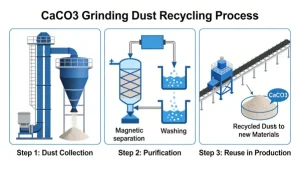
can CaCO3 grinding dust be recycled
Calcium carbonate (CaCO₃) grinding dust is highly recyclable and widely reused in industrial processes, offering...
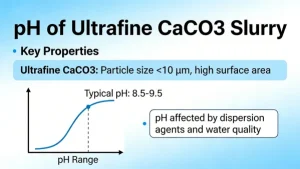
what is the pH of ultrafine CaCO3 slurry
The pH of ultrafine calcium carbonate (CaCO₃) slurry typically ranges from 8 to 10 under...
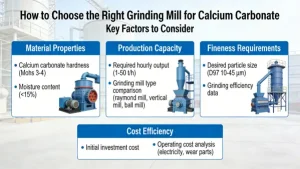
How to choose the right grinding mill for calcium carbonate
Start with a clear decision framework: first define production method (dry/wet), target fineness, and throughput,...