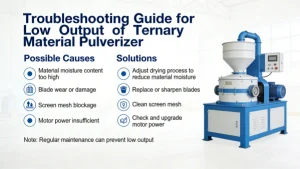
The ternary material pulverizer is a high-efficiency nitrogen-circulating grinding equipment specially designed for the processing of ternary materials. With a designed output of approximately 150 kg/h and an adjustable product particle size of D50 12 μm, it plays a critical role in ternary material production lines. However, in actual operation, low output may occur due to various factors such as equipment wear, mismatched parameters, and process defects. Based on the technical parameters, equipment configuration and process characteristics of the CSM350-VD pulverizer, this guide systematically analyzes the common causes of low output and provides practical troubleshooting methods to help users quickly restore the equipment to normal production efficiency.
1. Overview of Basic Information of the CSM350-VD Pulverizer
Before troubleshooting, it is necessary to clarify the core parameters and system composition of the CSM350-VD pulverizer to accurately locate problems. The equipment is equipped with an 11 kW grinding motor, a 2.2 kW classifying motor and a 5.5 kW customized induced draft fan for nitrogen circulation, with a total installed capacity of about 18.7 kW. The whole system adopts a PLC automatic control system and includes a nitrogen circulation system to control moisture and oxygen content, ensuring the purity and stability of ternary materials. Main equipment consists of the pulverizer mainframe, cyclone collector, pulse dust collector, quantitative feeding system and heat exchanger, all of which are closely related to output.
2. Common Causes of Low Output and Troubleshooting Methods
Low output of the CSM350-VD pulverizer is usually associated with raw material conditions, equipment components, process parameters, system operation and other factors. Detailed analysis combined with equipment configuration is as follows:
2.1 Problems with Raw Material Conditions
According to technical specifications, the raw material (ternary material) is required to have a particle size of less than 2 mm. Non-compliant raw materials will directly increase the load of the pulverizer and reduce production efficiency.
- Causes: The particle size of feed raw materials exceeds 2 mm, or agglomerates exist in raw materials, increasing grinding difficulty and prolonging grinding time.
- Troubleshooting Steps:
- Check the particle size of feed raw materials with a screen to confirm compliance with the requirement of less than 2 mm.
- If agglomerates exist in raw materials, add pre-grinding or screening processes before feeding to break up agglomerates and remove oversize particles.
- Ensure the uniformity of raw materials to avoid uneven feeding caused by uneven particle size distribution.
2.2 Wear or Fault of Key Equipment Components
As core components affecting output, the pulverizer mainframe, classifying system and feeding system will directly lead to reduced grinding efficiency in case of wear or fault.
2.2.1 Fault of the Pulverizer Mainframe
The mainframe of the CSM350-VD pulverizer adopts integrally sintered ceramic hammers, gear rings and guide shrouds, equipped with imported Swedish SKF bearings. Wear or damage to these components will impair grinding efficiency.
- Causes:
- Wear of ceramic hammers and gear rings reduces the grinding force on materials.
- Damage or poor sealing of SKF bearings causes unstable operation and reduced rotating speed of the grinding disc.
- Blockage of the quick-connect pipeline at the discharge port affects the discharge of ground materials.
- Troubleshooting Steps:
- Shut down the machine and cut off the power, disassemble the pulverizer mainframe, check the wear of hammers and gear rings, and replace worn ceramic components if necessary.
- Inspect SKF bearings for damage, oil shortage or poor sealing, and add lubricating oil or replace damaged bearings in a timely manner.
- Clean the quick-connect pipeline at the discharge port to remove material blockage and ensure smooth discharge.
2.2.2 Abnormality of the Classifying System
The pulverizer classifying system includes a 2.2 kW classifying motor, a zirconia-alumina composite ceramic classifying impeller and a variable frequency speed control system. Abnormal operation of the classifying system will result in unqualified product particle size and reduced effective output.
- Causes:
- Wear or blockage of the classifying impeller affects material classification efficiency.
- Improper variable frequency speed regulation of the classifying motor leads to mismatch between classifying speed and grinding speed.
- Troubleshooting Steps:
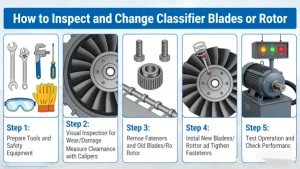
- Check the classifying impeller for wear or material blockage, and clean or replace the impeller if necessary.
- Adjust the frequency of the classifying motor according to the product particle size requirement (D50 12 μm) to ensure matching between classifying speed and grinding speed, avoiding excessive re-grinding or unqualified particle size.
2.2.3 Fault of the Quantitative Feeding System
The quantitative feeding system is made of stainless steel, equipped with a 50 L transition silo and a screw feeding mechanism. Uneven or insufficient feeding will directly reduce output.
- Causes:
- Blockage of the screw feeder (nylon screw) affects feeding speed.
- Failure of double pneumatic butterfly valves (PTFE-coated) leads to unstable feeding.
- Insufficient materials or uneven supply in the transition silo.
- Troubleshooting Steps:
- Check the screw feeder for blockage, clean the screw and ensure smooth feeding.
- Inspect pneumatic butterfly valves for air leakage or jamming, and repair or replace them if necessary.
- Ensure stable raw material supply in the transition silo, and adjust feeding speed via frequency conversion to match the grinding capacity of the pulverizer.
2.3 Abnormality of the Nitrogen Circulation System
The CSM350-VD pulverizer adopts a nitrogen circulation system to control moisture and oxygen content in the system, which is crucial to the stability of the grinding process. Abnormal operation of the nitrogen circulation system not only affects product quality but also reduces production efficiency.
- Causes:
- Failure of the customized induced draft fan (5.5 kW) for nitrogen circulation results in insufficient air volume and poor material circulation.
- Blockage or poor heat exchange efficiency of the heat exchanger causes excessive temperature in the system, affecting material grinding.
- Leakage of the nitrogen circulation system leads to unstable system pressure and reduced grinding efficiency.
- Troubleshooting Steps:
- Check the operation of the induced draft fan, including motor status and fan blade wear, and repair or replace it if necessary.
- Clean the heat exchanger to ensure favorable heat exchange efficiency and control the system temperature within a reasonable range.
- Inspect components such as nitrogen circulation pipelines and the 2 m³ balance tank for air leakage, seal leakage points in time to maintain stable system pressure.
2.4 Improper Setting of Process Parameters
The CSM350-VD pulverizer adopts a Siemens PLC automatic control system. Improper setting of process parameters (such as grinding speed, feeding speed and classifying speed) will cause low output.
- Causes:
- Excessively low rotating speed of the grinding motor leads to insufficient grinding force.
- Feeding speed is too fast or too slow, mismatched with grinding capacity.
- Improper setting of the oxygen analyzer results in excessive nitrogen consumption and unstable system operation.
- Troubleshooting Steps:
- Adjust the rotating speed of the grinding motor according to raw material characteristics and product requirements to ensure sufficient grinding force.
- Optimize feeding speed through the variable frequency system to match feeding volume with the pulverizer’s grinding capacity, avoiding overload or underloading.
- Calibrate the oxygen analyzer to ensure accurate monitoring of oxygen content in the system, adjust nitrogen supply volume to maintain stable system operation.
2.5 Blockage or Fault of Environmental Protection Equipment
The MB20 pulse dust collector (304 stainless steel, filtration area 20 m²) in the system is responsible for dust removal. Blockage or fault of the dust collector will affect system air circulation and reduce output.
- Causes:
- Blockage of PE-coated polyester fiber filter bags increases system resistance and causes insufficient air volume.
- Failure of the automatic pulse jet cleaning system results in poor dust removal efficiency.
- Troubleshooting Steps:
- Shut down the machine to clean or replace the filter bags of the pulse dust collector to ensure smooth air circulation.
- Inspect the automatic pulse jet cleaning system, including solenoid valves and oil-water separators, and repair or replace faulty components if necessary.
3. Preventive Measures to Avoid Low Output
To reduce the occurrence of low output, regular maintenance and standardized operation of the CSM350-VD pulverizer are essential. The following preventive measures are proposed based on technical service requirements:
- Regularly inspect key components (hammers, gear rings, classifying impellers, bearings, etc.) and replace worn parts in a timely manner.
- Strictly control raw material conditions to ensure raw material particle size and uniformity meet requirements.
- Regularly clean the feeding system, pulverizer mainframe, dust collector and pipelines to avoid material blockage.
- Regularly calibrate the PLC control system and various sensors (vibration sensors, temperature sensors, oxygen analyzers) to ensure accurate parameter setting and stable system operation.
- Train operators to master correct operation methods and troubleshooting skills, avoiding equipment faults caused by improper operation.
Conclusion
Low output of the ternary material pulverizer is mainly caused by raw material problems, equipment component wear, nitrogen circulation system abnormality, improper process parameter setting and environmental protection equipment failure. Targeted troubleshooting combined with equipment configuration and technical parameters in the attached documents, as well as implementation of regular maintenance and standardized operation, can effectively solve the problem of low output and ensure stable and efficient operation of the pulverizer. This guide provides users with a comprehensive and practical troubleshooting solution, helping users maximize the production efficiency of the equipment.