CaCO3
JACAN

How to Read & Interpret a Particle Size Distribution (PSD) Curve

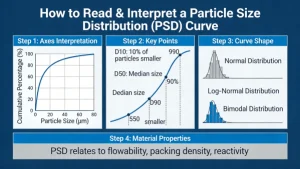
For mineral grinding (CaCO₃, graphite, etc.), the PSD curve is the most important chart to judge powder fineness & uniformity. Below is a step-by-step guide. 1. Basic Axes X-axis: Particle size (μm, nm)Usually logarithmic scale (common for powders). Y-axis: Cumulative distribution (%): % of particles smaller than a given size Differential (frequency): Volume/mass fraction at each size 2. Key Particle Sizes You Must Read These are the industry standard values for grinding: D10: 10% of particles are finer than this size D50 (Median diameter): Midpoint of distribution → main indicator of fineness D90: 90% are finer → controls coarse particles D97: Used for quality control in many industrial minerals How to read them: Draw a horizontal line from the Y-axis…

For mineral grinding (CaCO₃, graphite, etc.), the PSD curve is the most important chart to judge powder fineness & uniformity. Below is a step-by-step guide.

1. Basic Axes

  • X-axis: Particle size (μm, nm)Usually logarithmic scale (common for powders).
  • Y-axis:
    • Cumulative distribution (%): % of particles smaller than a given size
    • Differential (frequency): Volume/mass fraction at each size

2. Key Particle Sizes You Must Read

These are the industry standard values for grinding:

  • D10: 10% of particles are finer than this size
  • D50 (Median diameter): Midpoint of distribution → main indicator of fineness
  • D90: 90% are finer → controls coarse particles
  • D97: Used for quality control in many industrial minerals

How to read them:

Draw a horizontal line from the Y-axis percentage → intersect the cumulative curve → drop vertically to X-axis for the size.

3. Interpret Curve Shape

Cumulative curve

  • Steep slope: Narrow distribution → particles are uniform
  • Gentle slope: Wide distribution → mix of fine & coarse

Differential (frequency) curve

  • Single sharp peak: Good grinding, uniform size
  • Broad peak: Wide distribution
  • Double peak: Often means agglomeration, incomplete dispersion, or mixed feeds

4. Practical Meaning for Mineral Grinding

  • Smaller D50 = finer powder
  • Small difference D90 – D10 = narrow, high-quality PSD
  • High tail on the right (coarse side) = insufficient grinding
  • Left-side tail (ultra-fine) = may cause agglomeration
About Us:
With over 20 years of dedicated expertise in ultrafine grinding technology, we deliver high-performance machinery that matches the precision and reliability of leading German and Japanese brands—at only 1/3 of their cost.

Beyond Equipment, We Deliver Total Confidence:
We provide Free Material Testing to ensure precise equipment selection, followed by professional on-site installation and comprehensive training. Our 24/7 technical support team ensures your production line remains efficient and worry-free.

Schedule Material Trial & Get a Customized Solution from Us
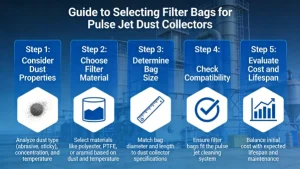
How to select the right filter bags for a pulse jet dust collector?
To select the right filter bags for a pulse jet dust collector, follow this step-by-step...
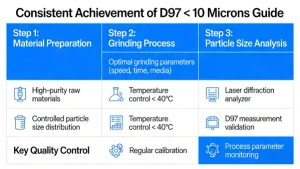
How to achieve a D97 of less than 10 microns consistently?
To consistently achieve a D97 < 10 microns (97% of particles smaller than 10 micrometers),...
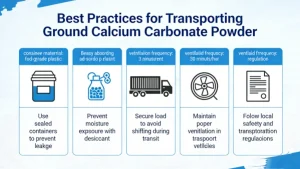
What is the best practice for transporting ground calcium carbonate powder?
Ground Calcium Carbonate (GCC) powder is generally non-hazardous (UN GHS unclassified), but requires careful handling...