Ultra-fine calcium carbonate (UFCC, particle size <10 μm, especially nano-CaCO₃ <100 nm) is prone to agglomeration due to its high surface energy, strong van der Waals forces, and surface hydroxyl groups that form hydrogen bonds. Agglomeration reduces powder flowability, dispersion quality, and application performance. Below is a systematic approach to prevention:
1. Understand Agglomeration Types and Causes
| Agglomeration Type | Mechanism | Prevention Strategy |
|---|---|---|
| Soft Agglomeration | Weak van der Waals/electrostatic forces | Surface modification, dispersion agents, proper drying |
| Hard Agglomeration | Chemical bonds (e.g., hydroxyl bridges) or sintering | Process control during synthesis/grinding, surface passivation, specialized drying |
| Moisture-induced | Capillary forces from adsorbed water | Low-moisture processing, moisture-proof storage |
| Mechanical compaction | Pressure during storage/transport | Anti-caking additives, proper packaging |
2. Surface Modification: The Most Effective Prevention Method
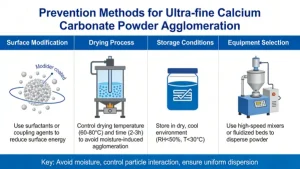
Surface modification changes particle surface properties to create electrostatic repulsion and/or steric hindrance between particles.
Common Modifiers and Their Mechanisms
| Modifier Type | Examples | Optimal Dosage | Mechanism | Application |
|---|---|---|---|---|
| Fatty acids/salts | Stearic acid, sodium stearate, oleic acid | 1-3 wt% | Hydrophobic coating reduces surface energy; forms monomolecular layer | Polymer fillers, plastics, rubber |
| Coupling agents | Silanes (KH550, KH570), titanates (KR-TTS), aluminates | 0.5-2 wt% | Forms chemical bonds with CaCO₃ surface; improves compatibility with organic matrices | Composite materials, coatings, adhesives |
| Polyelectrolytes | Polyacrylic acid (PAA), sodium polyphosphate | 0.2-1 wt% | Electrostatic stabilization (zeta potential >30 mV or < -30 mV) | Aqueous suspensions, papermaking, water-based coatings |
| Polymers | PEG, PVA, PP-g-MAH | 1-5 wt% | Steric stabilization via polymer chains | High-performance composites, pharmaceutical applications |
Modification Methods
- Dry Process: Mix UFCC with molten/dissolved modifier in high-speed mixer (650-1000 rpm) at 70-90°C for 15-30 min. Suitable for coupling agents and fatty acids.
- Wet Process: Add modifier to UFCC slurry (10-40% solids). For water-insoluble modifiers (stearic acid, titanates), pre-emulsify or saponify with NaOH.
- In-situ Modification: Add modifier during synthesis/grinding for immediate surface coverage, preventing initial agglomeration.
- Mechanochemical Modification: Apply mechanical energy (ball milling, jet milling) during modification to enhance coating uniformity.
Key Tip: For mixed systems, use composite modifiers (e.g., stearic acid + silane, 1:1 ratio) for synergistic effects.
3. Process Control During Production
Grinding Optimization
- Use grinding aids (0.1-0.5 wt%) during milling: polyphosphates, glycols, or fatty acids. They adsorb on fresh surfaces to prevent re-agglomeration.
- Employ jet mills or planetary mills with proper classification to avoid over-grinding and particle reattachment.
- Maintain optimal slurry concentration (30-50% solids) in wet grinding to balance viscosity and particle collision frequency.
Drying: Critical for Preventing Hard Agglomeration
Traditional drying methods (oven, rotary) cause severe agglomeration. Use these advanced techniques:
| Drying Method | Advantages | Operating Conditions |
|---|---|---|
| Fluidized Bed Drying | Continuous operation, “dry-deagglomeration” simultaneous | 80-120°C, 50-100 Hz vibration, uniform airflow |
| Spray Drying | Produces spherical particles with narrow size distribution | Inlet 180-220°C, outlet 80-90°C, atomization pressure 0.3-0.5 MPa |
| Freeze Drying | Minimizes hard agglomeration (no liquid-gas interface) | -40°C pre-freezing, 0.1-10 Pa vacuum, sublimation at 20-40°C |
| Azeotropic Distillation | Replaces water with n-butanol before drying to eliminate hydroxyl bridges | Azeotropic temperature (92°C), vacuum distillation |
Pro Tip: For nano-CaCO₃, use two-stage drying: first low-temperature (40-60°C) to remove free water, then moderate temperature (80-100°C) to remove bound water.
4. Dispersion Techniques for Specific Applications
Aqueous Systems
- Adjust pH to 8-10 (optimal for CaCO₃ surface charge).
- Add dispersants: sodium polyacrylate (0.3-0.8 wt%), hexametaphosphate (0.2-0.5 wt%).
- Use ultrasonic dispersion (20-40 kHz, 10-30 min) to break soft agglomerates.
- Maintain low solid content (5-15%) for stable suspensions; use high-shear mixing for higher concentrations.
Organic Systems (Polymers, Oils)
- Use surface-modified UFCC with compatible modifiers (e.g., silane for epoxy, titanate for PVC).
- Apply masterbatch technique: pre-disperse 40-60% UFCC in carrier resin before final mixing.
- Use high-shear equipment: twin-screw extruders, internal mixers, or three-roll mills.
5. Storage and Handling Best Practices
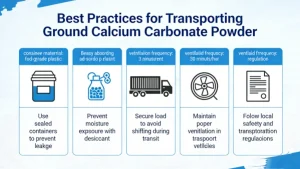
- Moisture Control: Keep relative humidity <60% during storage; use moisture-proof packaging (aluminum foil bags, sealed drums).
- Anti-Caking Additives: Mix with 0.1-0.5 wt% fumed silica, talc, or tricalcium phosphate to reduce interparticle contact.
- Packaging: Use flexible containers with minimal headspace; avoid excessive stacking pressure.
- Handling: Use pneumatic conveying instead of mechanical transport; maintain low velocity (10-15 m/s) to prevent particle attrition and re-agglomeration.
- Temperature: Store at 15-25°C; avoid temperature fluctuations that cause condensation.
6. Post-Production Deagglomeration (If Needed)
If agglomeration occurs despite precautions:
- Mechanical Methods: High-speed impact mills, jet mills, or ultrasonic treatment (effective for soft agglomerates).
- Chemical Redispersion: Add small amounts of original modifier or dispersant during reprocessing.
- Combination Approach: Mechanical deagglomeration followed by surface re-modification for best results.
7. Process Integration: A Holistic Strategy
Implement a preventive chain across the entire production cycle:
- Synthesis/Grinding: Add modifiers during particle formation when surface energy is highest.
- Drying: Use anti-agglomeration drying equipment with vibration/fluidization.
- Modification: Apply surface treatment immediately after drying.
- Storage: Package under controlled atmosphere (dry nitrogen) for long-term stability.
- Application: Use in-line dispersion systems to maintain particle separation until final use.
Key Success Factors
- Particle size control: Narrow size distribution reduces agglomeration tendency.
- Surface coverage: Ensure 90%+ particle surface is coated with modifiers.
- Zeta potential monitoring: Maintain absolute value >30 mV for electrostatic stability.
- Moisture management: Keep moisture content <0.5% for organic applications, <1% for general use.
By combining these strategies, you can effectively prevent agglomeration and maintain the desired properties of ultra-fine calcium carbonate powder throughout its lifecycle.